
iScrim E-Sports Platform
iScrim E-Sports
Platform
English
Timeline
8 Months
Role
Product Designer
Team
1x Designer, 3x Devs
Domain
e-Sports
Timeline
8 Months
Role
Product Designer
Team
1x Designer, 3x Devs
Domain
e-Sports
Tools & Stack
Figma
Slack
Notion
All project data & decisions documented here are my own. AI assistance was only used for structure and clarity.
All project data & decisions documented here are my own. AI assistance was only used for structure and clarity.
01Business Context & Competitive Landscape
iScrim was a Korean e-sports tournament platform built by Undefined Inc., designed for both independent players and organizers to host, manage, and participate in competitive gaming events. I joined as a full-time product designer in January 2022, working for 8 months before the team was laid off due to a funding constraint, a recurring reality in the indie esports startup space. The platform had an existing v2 in production and planning for v3 was already underway before I joined. The goal was to meaningfully improve the platform experience, standardize the UX, and expand the competitive ecosystem. iScrim targeted the Korean esports market primarily with English maintained for broader accessibility.01Business Context & Competitive Landscape
iScrim was a Korean e-sports tournament platform built by Undefined Inc., designed for both independent players and organizers to host, manage, and participate in competitive gaming events. I joined as a full-time product designer in January 2022, working for 8 months before the team was laid off due to a funding constraint, a recurring reality in the indie esports startup space. The platform had an existing v2 in production and planning for v3 was already underway before I joined. The goal was to meaningfully improve the platform experience, standardize the UX, and expand the competitive ecosystem. iScrim targeted the Korean esports market primarily with English maintained for broader accessibility.Success was defined by measurable platform growth: new user sign-up rate, number of competitions held, tournament winners, and daily active users on the homepage.
Success was defined by measurable platform growth: new user sign-up rate, number of competitions held, tournament winners, and daily active users on the homepage.
02Problem
iScrim v2 had traction but the experience was holding back retention and engagement. Players had no single place to view or manage their information. Tournament and platform news required leaving the site. The registration and roster flow was missing key steps. Getting from A to B required navigating through extra menus.02Problem
iScrim v2 had traction but the experience was holding back retention and engagement. Players had no single place to view or manage their information. Tournament and platform news required leaving the site. The registration and roster flow was missing key steps. Getting from A to B required navigating through extra menus.Business Problem
The platform lacked core features expected of a competitive gaming platform. No profile system, no news delivery, and inconsistent UX flows that created unnecessary friction across every common action.User Problem
Players had no single place to view or manage their information. Tournament news required leaving the platform. The registration and roster flow was missing key steps, and getting from A to B required navigating extra menus.Business Problem
The platform lacked core features expected of a competitive gaming platform. No profile system, no news delivery, and inconsistent UX flows that created unnecessary friction across every common action.User Problem
Players had no single place to view or manage their information. Tournament news required leaving the platform. The registration and roster flow was missing key steps, and getting from A to B required navigating extra menus.The specific gaps in v2
No dedicated profile page. No news system for platform or tournament announcements. Inconsistent UX flows where similar actions required different paths. A fragmented registration flow missing key steps. Extra menus adding unnecessary steps between every A and B.The specific gaps in v2
No dedicated profile page. No news system for platform or tournament announcements. Inconsistent UX flows where similar actions required different paths. A fragmented registration flow missing key steps. Extra menus adding unnecessary steps between every A and B.03My Role
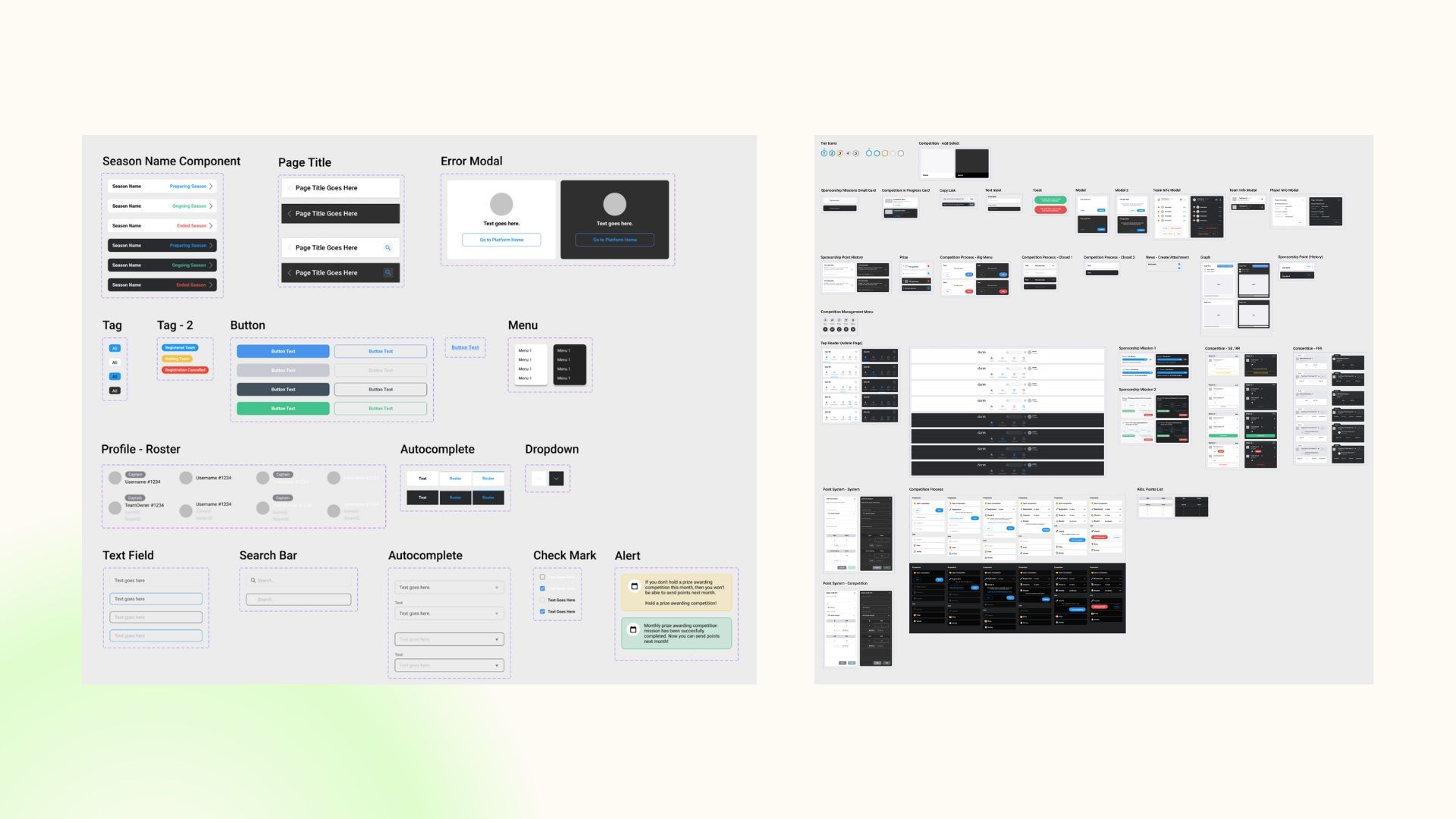
I was the full-time product designer at Undefined Inc. from January to August 2022. The 8-month engagement had four distinct phases: audit, redesign, ship, and iterate. Daily meetings with the PM kept design and development tightly aligned throughout. The design system was co-built with a fellow designer covering both Admin (organizer) and User (player) component sets, with a dark navy theme, blue primary accents, and full Korean/English bilingual support.01End-to-end UX and UI design for new features and improvements across both admin and user flows
02v2 experience audit by creating dummy accounts and documenting all flows firsthand
03UX flow standardization across the full platform
04QoL improvements based on team feedback and real usage patterns
05v2 to v3 upgrade across all platform surfaces: homepage, profile, teams, registration, and news
06Design system co-built with a fellow designer covering admin and user component sets
03My Role
I was the full-time product designer at Undefined Inc. from January to August 2022. The 8-month engagement had four distinct phases: audit, redesign, ship, and iterate. Daily meetings with the PM kept design and development tightly aligned throughout. The design system was co-built with a fellow designer covering both Admin (organizer) and User (player) component sets, with a dark navy theme, blue primary accents, and full Korean/English bilingual support.01End-to-end UX and UI design for new features and improvements across both admin and user flows
02v2 experience audit by creating dummy accounts and documenting all flows firsthand
03UX flow standardization across the full platform
04QoL improvements based on team feedback and real usage patterns
05v2 to v3 upgrade across all platform surfaces: homepage, profile, teams, registration, and news
06Design system co-built with a fellow designer covering admin and user component sets
04 Direction
I upgraded iScrim from v2 to v3, adding a dedicated profile and account management system, a homepage news hub, and a streamlined tournament registration and roster selection flow, while standardizing UX patterns across the platform to reduce the steps required for every common action. Every change was grounded in specific friction points identified through the v2 audit. This was not a redesign from scratch. It was a focused, evidence-based upgrade built on what v2 had already established.04 Direction
I upgraded iScrim from v2 to v3, adding a dedicated profile and account management system, a homepage news hub, and a streamlined tournament registration and roster selection flow, while standardizing UX patterns across the platform to reduce the steps required for every common action. Every change was grounded in specific friction points identified through the v2 audit. This was not a redesign from scratch. It was a focused, evidence-based upgrade built on what v2 had already established.05Impact
v3 launched successfully with a daily incremental shipping model, with improvements deployed continuously and full features released weekly. User retention increased post-launch as the core friction points were resolved. 05Impact
v3 launched successfully with a daily incremental shipping model, with improvements deployed continuously and full features released weekly. User retention increased post-launch as the core friction points were resolved. v3ShippedDaily improvements, weekly full releases
5Core Areas UpgradedProfile, news, registration, teams, homepage
8 MonthsTimelineAudit to shipped v3
v3ShippedDaily improvements, weekly full releases
5Core Areas UpgradedProfile, news, registration, teams, homepage
8 MonthsTimelineAudit to shipped v3
06Approach and Rationale
Rather than designing from assumptions, my first step was experiencing v2 as a user. I created dummy accounts across both the player and organizer flows and documented every step to map exactly where friction existed and how many extra steps common actions required. This became the foundation for every UX improvement in v3. Existing esports tournament platforms were also researched to understand category standards for profile systems, team management, and tournament flows.06Approach and Rationale
Rather than designing from assumptions, my first step was experiencing v2 as a user. I created dummy accounts across both the player and organizer flows and documented every step to map exactly where friction existed and how many extra steps common actions required. This became the foundation for every UX improvement in v3. Existing esports tournament platforms were also researched to understand category standards for profile systems, team management, and tournament flows.Key Design Decisions
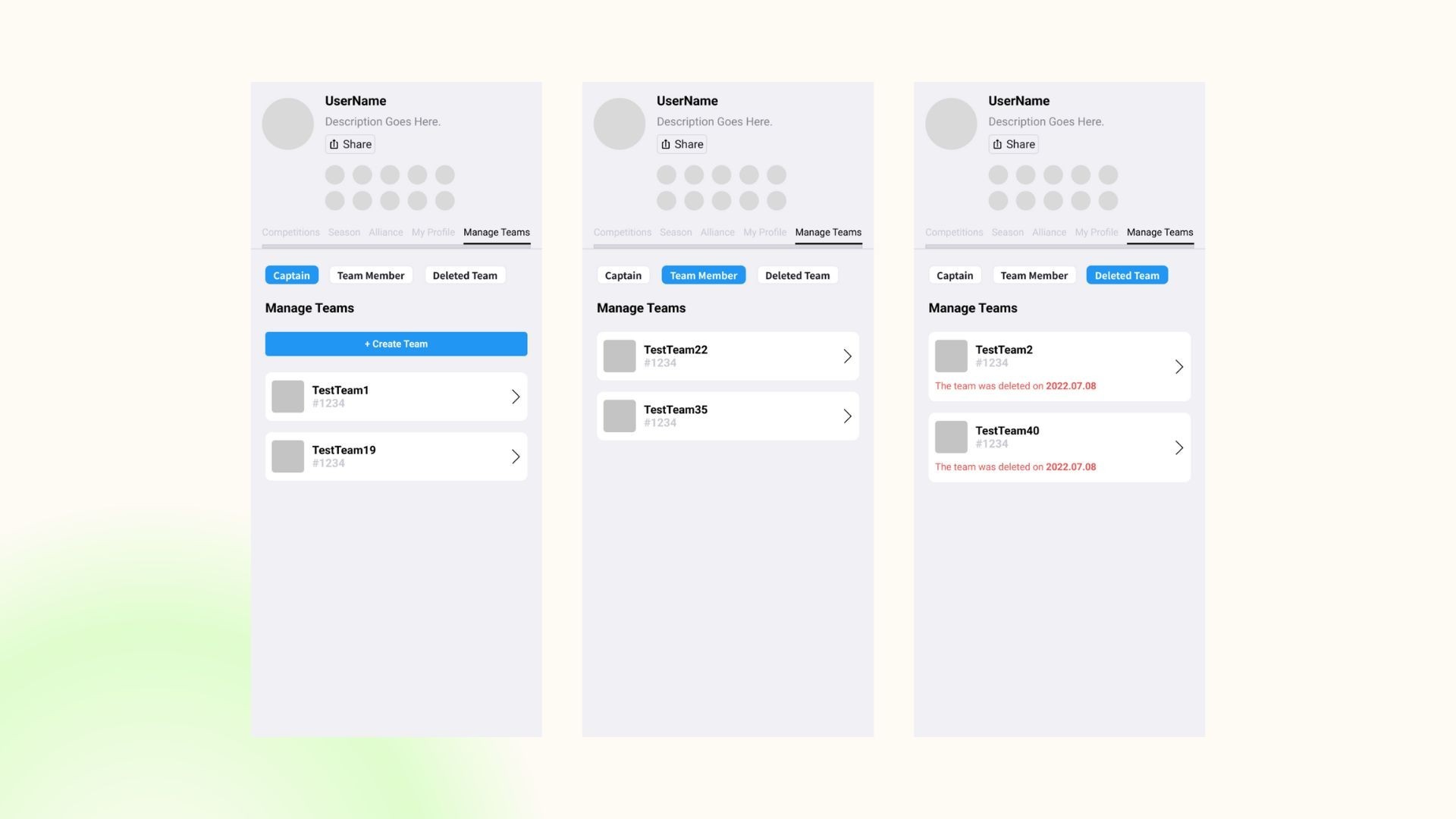
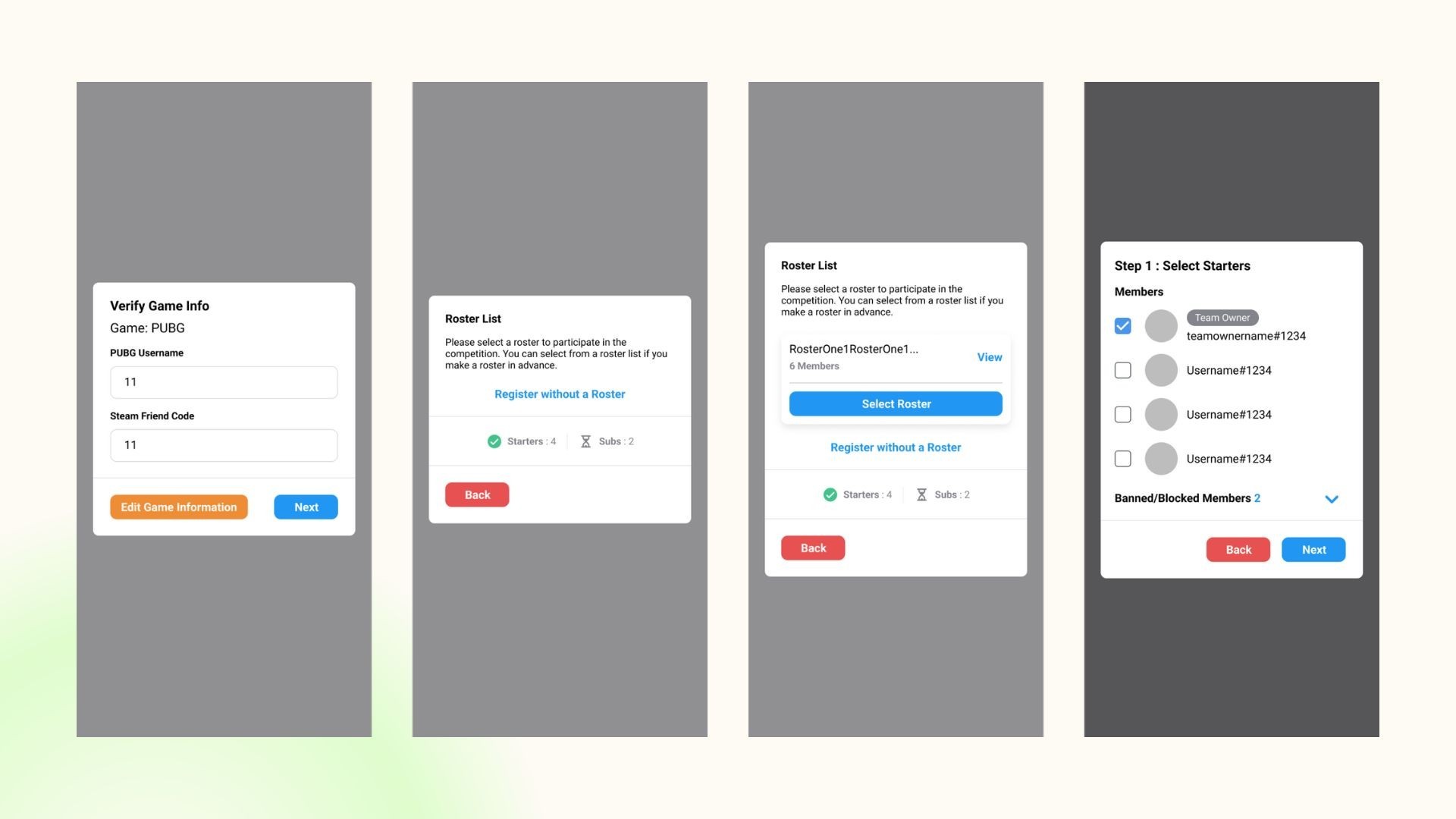
Team management needed to reflect real-world team dynamics. The same user could be a captain of one team and a member of another simultaneously, so the three-tab view (Captain, Team Member, Deleted Team) made all relationships visible in one place. Captain-only team creation was enforced at the UI level. The PUBG in-game screenshot verification in the registration flow was designed to cross-check player stats against profile claims without requiring game API access. Banned and blocked members surface directly in the roster selection step, preventing ineligible players from being added.Key Design Decisions
Team management needed to reflect real-world team dynamics. The same user could be a captain of one team and a member of another simultaneously, so the three-tab view (Captain, Team Member, Deleted Team) made all relationships visible in one place. Captain-only team creation was enforced at the UI level. The PUBG in-game screenshot verification in the registration flow was designed to cross-check player stats against profile claims without requiring game API access. Banned and blocked members surface directly in the roster selection step, preventing ineligible players from being added.07Final Solution
iScrim v3 shipped as a comprehensive upgrade across both the player and admin experiences. The platform is Korean-first with English maintained, covering six major areas.07Final Solution
iScrim v3 shipped as a comprehensive upgrade across both the player and admin experiences. The platform is Korean-first with English maintained, covering six major areas.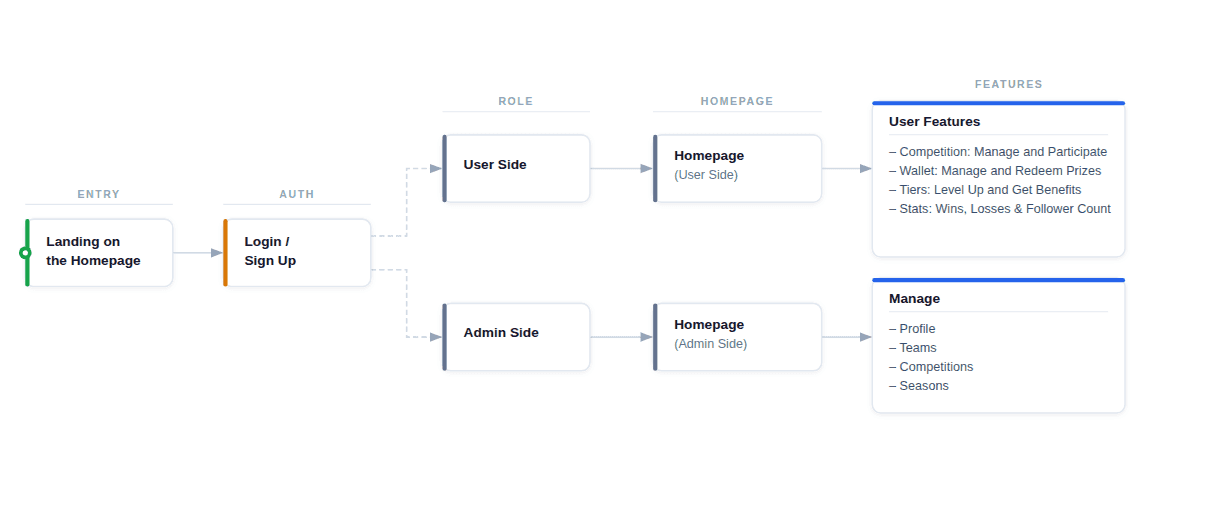
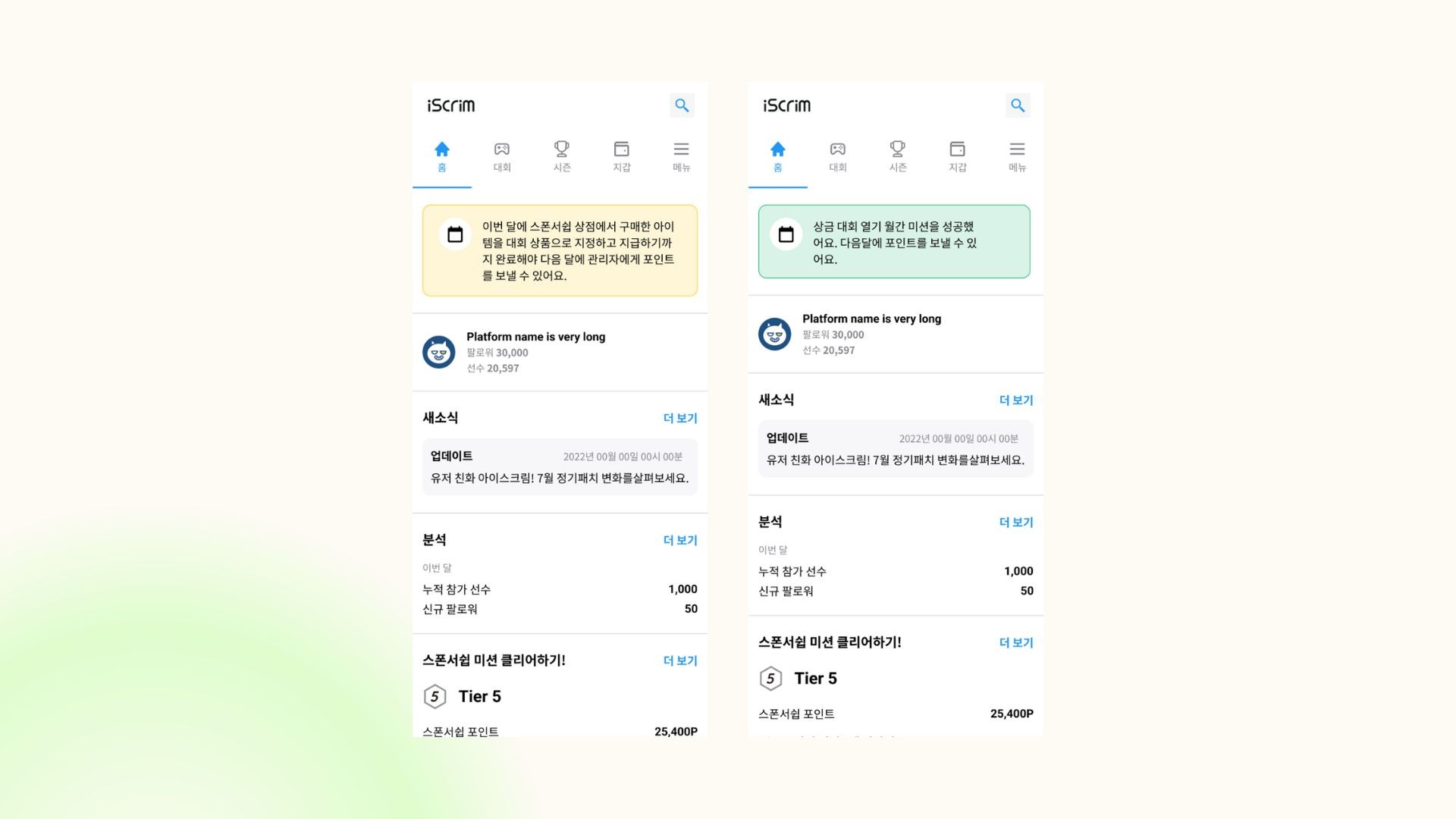
Homepage
Homepage
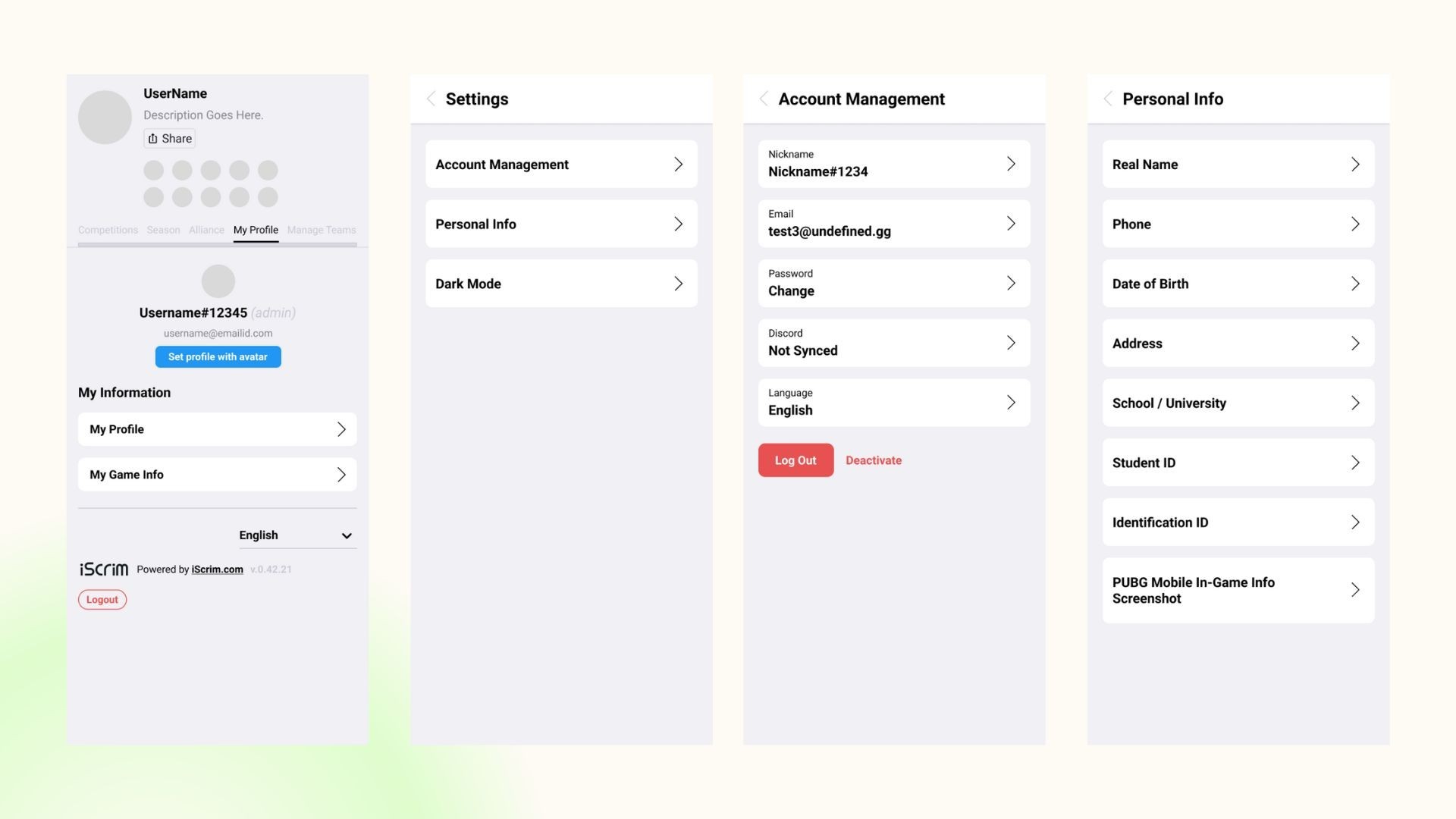
Profiles
Profiles
Teams
Teams
08 — Outcomes: What Worked
A list of pointers that worked.01Simplified user flows confirmed by team: fewer steps across all major platform actions
02Homepage news section resolved the most critical v2 gap: announcements now visible without leaving the platform
03Profile and account management gave users full self-service control for the first time
04Streamlined registration and roster flow removed the missing steps that had blocked smooth tournament participation
Limitations & Second-Order Effects
A list of things that we realised.01Specific retention metrics were not retained, so impact is confirmed qualitatively but not quantified
02Scope was not fully defined upfront, leading to mid-sprint adjustments
08 — Outcomes: What Worked
A list of pointers that worked.01Simplified user flows confirmed by team: fewer steps across all major platform actions
02Homepage news section resolved the most critical v2 gap: announcements now visible without leaving the platform
03Profile and account management gave users full self-service control for the first time
04Streamlined registration and roster flow removed the missing steps that had blocked smooth tournament participation
Limitations & Second-Order Effects
A list of things that we realised.01Specific retention metrics were not retained, so impact is confirmed qualitatively but not quantified
02Scope was not fully defined upfront, leading to mid-sprint adjustments
09 — Reflections: What I'd Do Differently
Define scope first: Establish clearly which features are in and out before any design work begins. Mid-sprint scope changes cost time and create inconsistency. More structured team discussion: Daily meetings were valuable but feature planning needed documented decisions to reduce ambiguity. Deeper research upfront: The v2 audit and competitor research were done, but more thorough user research before design would have surfaced nuanced pain points earlier.What I Learned
Audit by doing: Making dummy accounts and experiencing the platform as a real user was the most valuable research method on this project. Nothing reveals friction like actually trying to use the product. Collaborative design systems: Co-building the system with another designer while moving fast produced better consistency than one person maintaining it alone. Ship often, refine continuously: Daily incremental improvements and weekly releases proved that shipping directionally right and iterating beats waiting for a perfect release every time.09 — Reflections: What I'd Do Differently
Define scope first: Establish clearly which features are in and out before any design work begins. Mid-sprint scope changes cost time and create inconsistency. More structured team discussion: Daily meetings were valuable but feature planning needed documented decisions to reduce ambiguity. Deeper research upfront: The v2 audit and competitor research were done, but more thorough user research before design would have surfaced nuanced pain points earlier.What I Learned
Audit by doing: Making dummy accounts and experiencing the platform as a real user was the most valuable research method on this project. Nothing reveals friction like actually trying to use the product. Collaborative design systems: Co-building the system with another designer while moving fast produced better consistency than one person maintaining it alone. Ship often, refine continuously: Daily incremental improvements and weekly releases proved that shipping directionally right and iterating beats waiting for a perfect release every time.The biggest lesson from iScrim: the best way to understand a product's problems is to become its user. No amount of stakeholder discussion replaces the clarity of experiencing friction firsthand. That instinct, audit before design, is something I have carried into every project since.
The biggest lesson from iScrim: the best way to understand a product's problems is to become its user. No amount of stakeholder discussion replaces the clarity of experiencing friction firsthand. That instinct, audit before design, is something I have carried into every project since.